New Year with Gusto

On the Set with Roosevelt

On the Set with Roosevelt

The new year is starting with a very busy schedule of events, theater and more.

I am finalizing a one man play entitled “Roosevelt”! that will premier at the Donna Reed Theater in February.  This is an exciting time as I pull together the set, finalize the script and add the elements that make a play engaging, memorable and entertaining.  Roosevelt himself said “It is better to wear out than rust out” and there are many days where being worn out is how I finish my day.

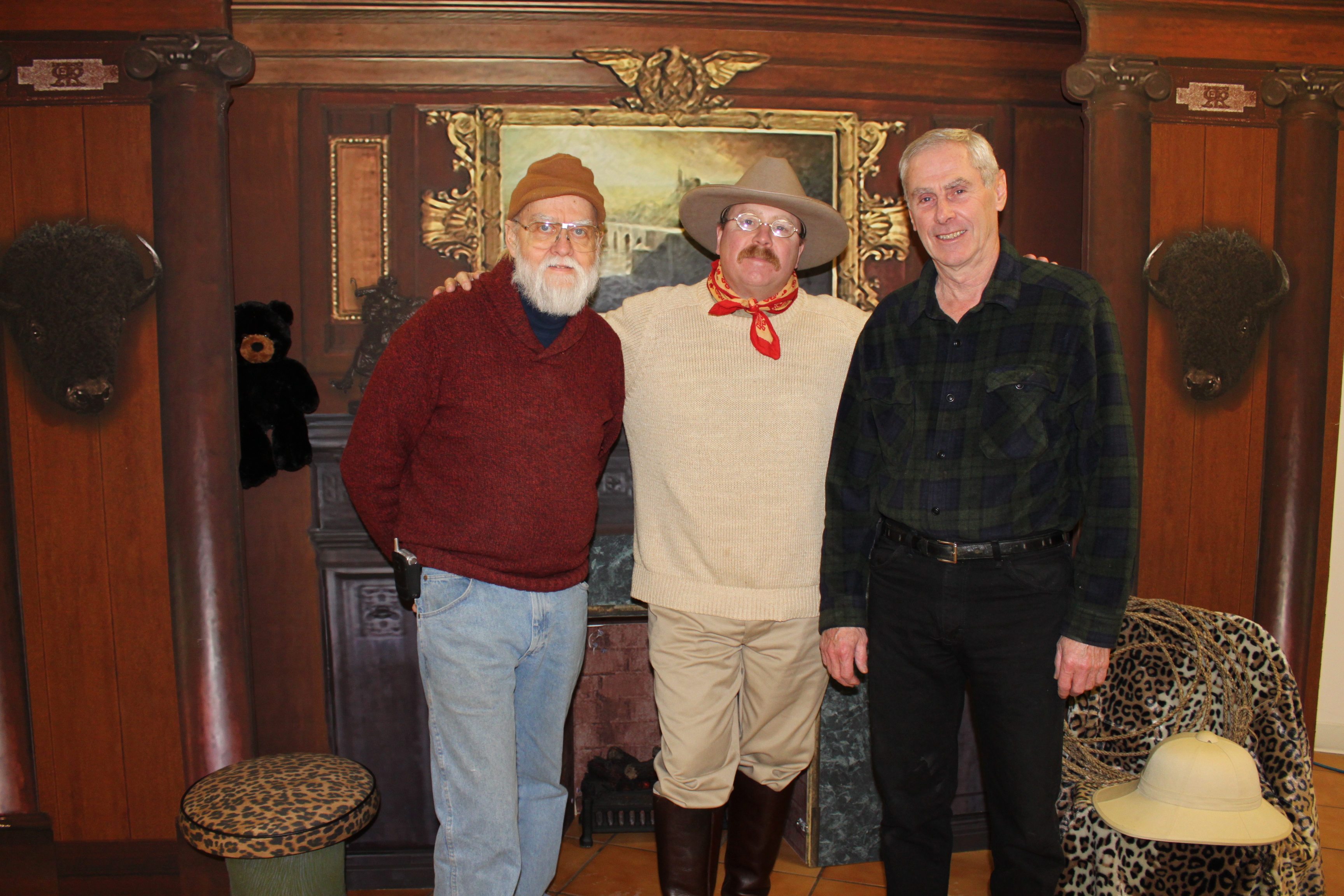
When I envisioned how the set would look, I decided to recruit my artist friend to help me develop the concept.  We both agreed that an easy to set-up set was important, but that it had to truly set the stage of the “largess” of the man.  As you can see by a few of the elements as we stand in front of  a portion of the set, I found the right helpers!  The amazing part is that two people can snap together the panels in less than 10 minutes and entire ensemble stores flat and is designed to get through a standard door. (it was designed for theaters, so that other part was more about getting it out of the house once we built it)

This set will be used in inside events I do only, and mostly Theaters.  However, there may be a few opportunities where I could include it in other Roosevelt presentations, such as the one I just did for the Mountain Lake Historical Society, which you can read about in the “Travels with Teddy” portion of this blog.

My calendar is filling fast and I am blessed to be able to recreate a most amazing man.  I am looking forward to the adventures!

Veterans Day with Roosevelt

IN HONOR OF VETERANS DAY, Nov. 11, 2014 —Minnesotan Adam Lindquist’s award-winning portrayal of America’s 26th president, Theodore “Teddy” Roosevelt, entertained a roomful of guests and veterans at Covenant Village of Golden Valley on Tuesday, Nov. 11. Pictured, left to right, Brooklyn Park, Minn.-resident Marvin Ceynar; Adam Lindquist as Teddy Roosevelt; and U.S. Navy veteran and Covenant Village of Golden Valley resident Wally Swanson.

IN HONOR OF VETERANS DAY, Nov. 11, 2014 —Minnesotan Adam Lindquist’s award-winning portrayal of America’s 26th president, Theodore “Teddy” Roosevelt, entertained a roomful of guests and veterans at Covenant Village of Golden Valley on Tuesday, Nov. 11. Pictured, left to right, Brooklyn Park, Minn.-resident Marvin Ceynar; Adam Lindquist as Teddy Roosevelt; and U.S. Navy veteran and Covenant Village of Golden Valley resident Wally Swanson.

Veteran’s Day as we know it didn’t exist when Roosevelt was President.

It wasn’t until November 1919 that President Wilson proclaimed November 11 as the first commemoration of Armistice Day with the following words: “To us in America, the reflections of Armistice Day will be filled with solemn pride in the heroism of those who died in the country’s service and with gratitude for the victory, both because of the thing from which it has freed us and because of the opportunity it has given America to show her sympathy with peace and justice in the councils of the nations…”  It was in honor of “The war to end all wars”.

Even though we did not have an “official” day at the time, Roosevelt acknowledged the sacrifices of those who came before, often citing those who fought in the Civil War in many speeches he presented.  The importance of Patriotism, sacrifice and honor are prevalent in the majority of Roosevelt speeches.

TR also spent much time after the Spanish American War with his “Rough Riders”.  These events were very popular with those who served, and even though Roosevelt wasn’t able to attend the 10th Anniversary, this gives you and idea of what many reunions must have been like:

Monday, Dec. 14, 1908

The Rough Riders, the regiment Theodore Roosevelt led in Cuba during the Spanish-American War, held their 10th annual reunion last night at the Union League Club. Roosevelt did not attend, but Major Gen. Leonard Wood, “the first Colonel of the Rough Riders,” did. Roosevelt’s regrets are quoted: “I wish I could be present at that dinner, but it is out of the question. Give my warmest regards to all present. The flag we carried is, I think, in Arizona. Personally, I should deem it very unwise to keep sending it around the country to the different reunions.” His wishes were not followed. “Col. Benson went to Arizona and got the flag. … The first toast drunk was ‘To the Dead,’ and was drunk in silence. Gen. Wood proposed the toast, ‘To the President of the United States.’ He told in an impromptu speech of the difficulties in clearing Santiago, and later Havana, of the yellow fever peril, also of his work in the Philippines, and said that, whatever he may have accomplished there, it was materially helped by the enthusiastic support given by President Roosevelt. … One of the most interesting features of the evening was the singing of the Rough Rider song by Col. Emerson. This song, which has about a thousand or so verses, was composed by Col. Emerson while the regiment was on duty in Cuba. It has been added to at almost every special occasion since. The chorus goes thus: ‘Rough Riders we are, from the West,/Green tenderfeet the rest,/Of mounted men the best./Rallied at Woods’ and Roosevelt’s behest/To carry our way to glory.’ Col. Emerson sang verses until he was tired, and early this morning the Rough Riders were still chanting the chorus as they went homeward.”

On a personal note, I would like to take a moment to thank those who served and to honor those who gave their lives so that we could be free.  Thank you is not enough to say for all you have done.


Roosevelt’s Tiffany Bowie Knife

Only Tiffany would do for TR

Only Tiffany would do for TR

I had a client send me an article of the 1st public reference of the word “dandy” and the writer claimed it was about Theodore Roosevelt.  You can see by this photo why the guide who was hired to take him on the Bison hunt in Dakota Territory called him a “dandy” and why he had second thoughts about the whole thing when this man got off the train.  The high voiced spectacled man insisted he wanted to hunt on horseback and the guide informed him that no “greenhorn” from the east was going to use any of his horses – Roosevelt would ride in a buckboard.  It was only after Roosevelt offered to pay $50 for one of the man’s horses that he was able to get what he wanted – and show the man he could actually ride.

Roosevelt first went to the badlands to hunt that bison and he had his clothing, knife and gun made to his specifications.  Of course, he had the local photographer take his photo in studio to show the amazing outfit he had assembled – The buckskin shirt you see on him here was made for him for the outlandish price of $100 – a steep amount indeed (when you consider he offered to buy a horse for $50).  But when you add the silver and gold gun with ivory handles and the knife you see tucked in his buck skin pants, his investment just to look good for his bison hunt is impressive.  His bowie knife was made by his friends at Tiffany’s – who would supply him for much of his life.  In fact, it was Tiffany who funded special rifles for the Rough Riders at Roosevelt’s request.

I was fortunate to come upon a reproduction of his knife which I take in a glass case to many of the events at which I speak.  The side you see here pictures Davy Crocket, on the flip side is his name spelled out in cursive.  The blade on the Davy side features bears, while the opposite has a scenic deer motif.  The knife is silver and heavy and larger than life, just like its owner was!

Only the best for “Teddy”.

He killed a cougar once with only a knife:-

Keystone Ranch, Colo., Jan. 14th, 1901 –
“Soon we saw the lion in a treetop, with two of the dogs so high up among the branches that he was striking at them. He was more afraid of us than of the dogs, and as soon as he saw us he took a great flying leap and was off, the pack close behind. In a few hundred yards they had him up another tree. This time, after a couple of hundred yards, the dogs caught him, and a great fight followed. They could have killed him by themselves, but he bit or clawed four of them, and for fear he might kill one I ran in and stabbed him behind the shoulder, thrusting the knife right into his heart. I have always wished to kill a cougar as I did this one, with dogs and the knife.”

Was it the silver 1884  Tiffany Knife?  We’ll never know!


Why Roosevelt was different than other Presidents

Speaking to the people

Speaking to the people

I have had a lot of discussions with people after the mini-series on PBS and I am amazed at the different perceptions / comments on how they felt Burn’s portrayed TR.   A few comments have centered around the idea that Roosevelt was a “war monger” or “quick to decision”.  Here is my rebuttal to both:

Dig deeper than the PBS series could.

“Speak softly and carry a big stick” was a preventative approach to war, not the reason for one.  Roosevelt knew that having a strong military and showing the world that the United States was prepared to take action if attacked, meant that the potential enemies would think twice before doing so.  They did – The United States was not involved in any major conflicts during Roosevelt’s Presidency.  (We did support Panama in their quest for independence, but the U.S. was not directly named in the conflict)  Additionally, Roosevelt was the first American to win the Nobel Peace Prize for his work with brokering peace in the Russo- Japanese War.  That’s not very “war mongering” – it actually is the exact opposite.

As a leader in the battle of San Juan Heights, TR lost friends and many of his men, so he knew the direct cost of war.  His position was peace, with an understanding that he would defend his countrymen if we were placed in a position to do so.

The idea that he was too quick in making a decision I would frame with an understanding of the man.  Roosevelt was an extremely well read historian with a photographic memory.  When he looked at a problem, he did so with a computer-like mind, sifting through history  to assess other societies faced with similar circumstances. He then compared that to his current time, along with inputs from those around him.   His decisions were quick in the sense that he didn’t dawdle,  but to imply that being quick meant they were not well reasoned would frankly place the odds against him.  Most of his decisions of the time are still embraced as laws and common sense we follow today.  The Pure Food and Drug Act, the Meat Inspection Act, the National Forest Service, National Wildlife Refuges, National Monuments.  Roosevelt made decisions as a leader looking to the future, based on the current needs and experiences and history of the past.   His decisions continue today to be embraced, meaning he beat the odds -few of his ideas have been replaced with better ones.  That’s why today’s politician’s want to be measured as “good as TR”


The Roosevelt’s on PBS

The Theodore Roosevelt Family

The Theodore Roosevelt Family

For weeks, everyone who knows that I portray TR has been contacting me to remind me of Ken Burns PBS series on The Roosevelt’s.  I am as excited to see it as anyone, as my research is so focused on the man I portray that I seldom get to research the dynamics of the “other players” – Eleanor and Franklin.  I am eager to learn about the family on the “Hyde Park” side.

Ken Burns and his team do an amazing job of condensing important historical moments into entertaining clips that give you a glimpse into history.  Many of the photographs they are able to assemble are rare archives of a lost time that truly give you a sense of the past in a meaningful way.  I recommend everyone take the time to watch this great show and learn more about the family that we hold as true American leaders.

Teddy Roosevelt and Healthcare

Teddy Roosevelt

I was recently asked to speak about healthcare at an event about the Affordable Care Act and President Obama’s reference to Teddy Roosevelt as the creator of the concept.  The research to get the answer of how that comment came to be meant many hours of in-depth reading and even more on health in the United States during the Roosevelt Presidency.

There were two major events that were part of Roosevelt’s Presidency that speak to the health of the nation.  During his time, professionally trained physicians were just coming into their own.  Because of this, Patent medicines, that promised “miracle cures” and that could be delivered by mail were the accepted way that many treated their healthcare concerns.  Add to that “electric belts” and a variety of inventions, and the population was looking for anyway they could to overcome their infirmities.  The money that was being made by these “snake oil” salesman made many very wealthy.  So much wealth was being made that one enterprising entrepreneur even offered to pay the entire bill for the Statue of Liberty if he could make the base an advertisement for his patent medicine.

Roosevelt knew that people were being harmed by these claims and risking their lives by taking them.  He enacted the Pure Food and Drug Act,  requiring that accurate ingredients be listed to warn the consumer of the what they were taking.  Certain ingredients were included on the Government list of harmful, including cocaine, opium and cannabis.  It also allowed for penalty to medicines that in name made impression that certain ingredients were inside, but that in actuality did not exist in the products.

On the same day, he also passed the Meat Inspection Act, allowing the government to control the inspection of beef and purity of meat goods sold, thus protecting the public from poorly preserved or dangerous meat that injured or killed.  (badly canned beef was responsible for many deaths during the Spanish-American War, in which Colonel Roosevelt participated as a Rough Rider).

These two Acts had significant impact on the health of Americans and continue to exist today in modified forms of government oversight and regulation.  Healthcare as we know it today was delivered by a fee for service model, with costs being affordable for many.

After he left the Presidency, Physician skills and medical technology had come a long way, and citizens were interested in accessing the new technology in an affordable way.  Because most medical expenses were paid for out-of-pocket, the new technologies had become treatments for those who could afford them.  A few larger companies offered access, but the general labor population and rural areas did not have easy access to the new innovations.

It wasn’t until he ran for President again in 1912 as a Progressive that his platform would include the idea of  a more nationalized healthcare idea.   Roosevelt’s concept was labor based, with burden for costs shared between workers, employers and the government.   It was indeed progressive, and was not embraced by those who saw it as competition to making money with medicine.

If he would have been elected, we might have seen a large amount of the populace covered by a healthcare plan.  Wilson was elected, crushing the idea until 100 years later.

I believe this quote from 1910 reinforces that if Roosevelt would have taken the Presidency, Healthcare would have been a high priority:

“Of all the questions which can come before this nation, short of the actual preservation of its existence in a great war, there is none which compares in importance with the great central task of leaving this land even a better land for our descendants than it is for us.  Let me add that the health and vitality of our people are at least as well worth conserving as their forests, waters, lands, and minerals, and in this great work the national government must bear a most important part.”

Roosevelt believed that hard work paid rewards, and giving hard-working Americans access to maintain their health to accomplish mighty things would have been high on his list.


A Fair idea

The Theodore Roosevelt Family

The Theodore Roosevelt Family

This past week I had set up my camp at a County Fair, the first time ever doing so.  In most events I do, I am at a school or show where there are mostly students or a corporate or government event with only adults.  This was a very rare experience to have entire families to visit and enjoy spending time.  I was left with some very rewarding memories and a hope for the future generation.

The majority of children I met were attentive, well behaved and had great questions.  The parents were equally interested in making sure their children understood the moment they were having was a unique opportunity to be able to talk to Roosevelt and learn.   I also made sure that those parents learned along the way too!

One of the most rewarding conversations was on a Sunday morning where I sat down in camp with a couple and we started talking about their interest in history.  As we spoke, we all agreed that to truly understand our country, you need to start at the beginning of the United States.  (The natives are our first true American’s, but in this conversation we spoke of the formation of the United States in relation to King George)

I set them out on a homework assignment which I assumed they would do later in the week.  However, they came back within an hour and we sat down again and had another fantastic discussion.  Here was the homework assignment: Read the last sentence of the Declaration of Independence.

All most all of us know the beginning of the second paragraph.  “We hold these truths to be self-evident, that all men are created equal….”  But it is the last sentence that shows to the extent that the men and women who created our American experiment were willing to go. “And for the support of this Declaration, with a firm reliance on the protection of divine Providence, we mutually pledge to each other our Lives, our Fortunes and our sacred Honor.”

Now I have a homework assignment for you:  Read that last sentence again and ask yourself, how far would you go to protect what they created for you?


Roosevelt and today’s Grand Canyon

“In the Grand Canyon, Arizona has a natural wonder which is in kind absolutely unparalleled throughout the rest of the world. I want to ask you to keep this great wonder of nature as it now is. I hope you will not have a building of any kind, not a summer cottage, a hotel or anything else, to mar the wonderful grandeur, the sublimity, the great loneliness and beauty of the canyon. Leave it as it is. You cannot improve on it. The ages have been at work on it, and man can only mar it.”

When Roosevelt made those words, he recognized that the canyon had a special place in America and that those looking to exploit it would go to any means to do so.  It was because of this that he declared the Grand Canyon a National Monument using the Antiquities Act.

Today, places like the Grand Canyon may seem protected, but the reality is that they are not as protected as Roosevelt himself would have wanted.  The Grand Canyon is facing the exact issues today that TR rallied against, development along the edge by business people who want to take advantage of the millions of people who visit annually.

While we all appreciate conveniences, the reality is that natural surroundings are made by the ages, while the interruptions of those surroundings are ruined in only a few days as bulldozers make flat places to put up those conveniences.   We need places where solitude, reflection and natural beauty are the only thing we experience, and we need to make sure we protect these not only for ourselves, but the multiple generations that will follow.

“Of all the questions which can come before this nation, short of the actual preservation of its existence in a great war, there is none which compares in importance with the great central task of leaving this land even a better land for our descendants than it is for us.”

Jobs and capitalism are an important part of the American fabric, but they do not replace the common sense to preserve natural resources that are unique on the globe.   As you think about the millions of acres that Roosevelt helped preserve, contemplate this: If his actions had not been taken, what might they look like today?


Work worth doing

“No man needs sympathy because he has to work, because he has a burden to carry. Far and away the best prize that life offers is the chance to work hard at work worth doing.” Theodore Roosevelt

TR and Secretary of the Interior Jewell discussing the Organ Mountains

TR and Secretary of the Interior Jewell discussing the Organ Mountains

When I received the call to come to Washington D.C. and appear as Roosevelt on Halloween day, I was more than sure that the call was a joke.  However, the client seemed sincere about why they wanted me and I had a very specific job:  Encourage the Secretary of the Interior to talk to her boss, President Obama, about using the Antiquities Act to preserve land.  TR had created the act as a presidential ability to make sure that certain areas of cultural, wilderness and heritage value could remain intact for future generations.

Secretary Jewell and I met in the hallway that day and spoke for several minutes before she made her first public comments in her new job.  She told me to listen to her speech, as she was going to reference Roosevelt several times.  Each time she did, she smiled at me or reminded the crowd at the National Press Club that “Teddy” was not only with her in spirit, but in person.

Secretary Jewell and the modern Teddy Roosevelt would meet many more times over the coming months, with a much clearer message: use the Antiquities Act to make the Organ Mountains – Desert Peaks, in Las Cruces New Mexico, a National Monument.

Obama gave hints that my conversations were hitting home.  In January, he made reference that he was poised to use the act in the State of the Union address, his first time in mentioning the capability.  A few weeks later he did just that, preserving a coastline of California, Point Arena-Stornetta Public Lands National Monument and hinting that more were on the horizon.  I received a note from my client telling me that he had confided to a reporter that he was “poised” to protect the Organ Mountains if Congress didn’t.  We have sat for many months waiting for any news on the progress, hopeful.

This morning, I received an invite from the Secretary of the Interior’s office to celebrate the Organ Mountains – Desert Peak National Monument.  496,000 acres of land, protected for future generations.   I hope TR is pleased with my work, even if it is being carried on by just a man who looks like him.

Theodore Roosevelt and Religion

Teddy Roosevelt

Theodore Roosevelt believed in God and believed that people needed to read every-book they could get their hands on, including the bible.

“A thorough knowledge of the Bible is worth more than a college education”.

Roosevelt’s beliefs were based on his viewpoint that if you were not God-fearing you might consider yourself above the laws of man.

“To educate a man in mind and not in morals is to educate a menace to Society”

A thorough knowledge of the Bible is worth more than a college education
Read more at http://www.brainyquote.com/quotes/quotes/t/theodorero147900.html#LLRGb3Hd1PuSJVZW.99

Roosevelt was a regular church goer, having been raised in the Dutch Reformed Church.

The Dutch Reformed Church went with migrants to the Americas, beginning in 1628 in New Amsterdam.

In Canada and the United States, the oldest and second largest body is the Reformed Church in America, which was the American branch of the Dutch Reformed Church in the Netherlands between 1628 and 1819. The largest body in North America is the Christian Reformed Church in North America, which split off from Reformed Church in America in 1857. Smaller related denominations and federations are the Canadian and American Reformed Churches, the Free Reformed Churches of North America (FRC), the Heritage Reformed Congregations (HRC), the Netherlands Reformed Congregations (NRC), the Protestant Reformed Churches in America (PRC), and the United Reformed Churches in North America (URC). Former US Presidents Martin Van Buren and Theodore Roosevelt, both of Dutch descent, were affiliated with the Dutch Reformed Church

Roosevelt was a lifelong devotee to this faith. However, during large stretches of his life, he was unable to physically find a church to attend. Thus, he often attended Episcopal services, as his wife was an Episcopalian. He once said:

“When I first came to Washington, I did not know there was any Dutch Reformed Church there, and went with my wife to the Episcopal Church. But, on becoming President, I learned that there was a little obscure, red brick building tucked away on the back of a lot, and I immediately selected that as my Church.

Roosevelt was involved with an Episcopalian denomination in Brazil during his travels to that country, and by the time he had largely retired from public life in Oyster Bay, Long Island, he was a regular attendee, with his wife, at an Episcopalian church there–the “Christ Church of Oyster Bay.” They still list Roosevelt as one of their former parishioners.


Roosevelt, like many of the time had bias as to how he saw the world and of course his spiritual views contributed to part of the complex man he was.  He believed you could clearly see God in the manifest of nature, and that certain places on earth, such as Yosemite and The Grand Canyon were perfect examples of things that could only be created by God.

A special thank you for some of the Dutch Reformed information from the website http://hollowverse.com/theodore-roosevelt/